


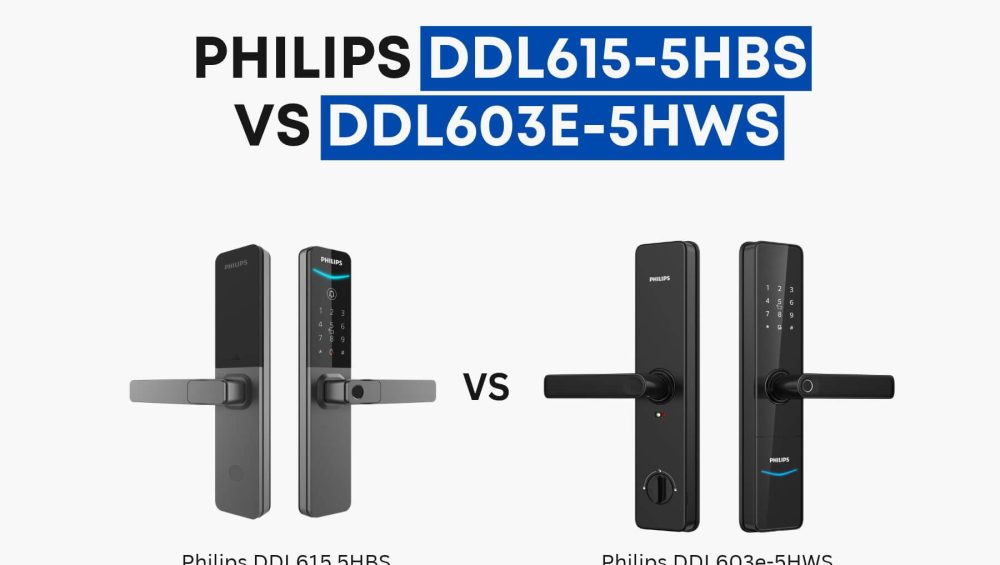
Choose the Philips DDL603E-5HWS if built-in Wi-Fi and remote access management are important to you. Choose the Philips DDL615-5HBS if you want a more affordable, compact fingerprint smart lock with Bluetooth connectivity and flexible PIN management.
Both Philips smart locks support fingerprint access, PIN codes, key tags, mechanical-key backup, hidden PIN protection, and dual verification. But their connectivity, dimensions, mortise requirements, battery systems, and pricing are very different.
For homeowners, landlords, and property managers in Dubai and the UAE, the better choice depends on more than features alone — your door compatibility and the way you intend to manage access matter just as much.
Philips DDL615 vs DDL603E: Quick Comparison
| Feature | Philips DDL603E-5HWS | Philips DDL615-5HBS |
|---|---|---|
| Lock Type | Smart Lever Door Lock | Compact Smart Lever Door Lock |
| Connectivity | Wi-Fi | Bluetooth |
| Fingerprint | Yes | Yes |
| PIN Code | Yes | Yes |
| Key Tag | Yes | Yes |
| Mechanical Key | Yes | Yes |
| Temporary PIN | Yes | Yes / Offline access-control PIN |
| Fingerprint Capacity | Up to 100 | Up to 100 |
| Key Tag Capacity | Up to 100 | Up to 100 |
| User PIN Codes | Up to 20 | Up to 20 |
| Offline Access-Control PINs | — | Up to 250 |
| Dual Verification | Yes | Yes |
| Hidden PIN | Yes | Yes |
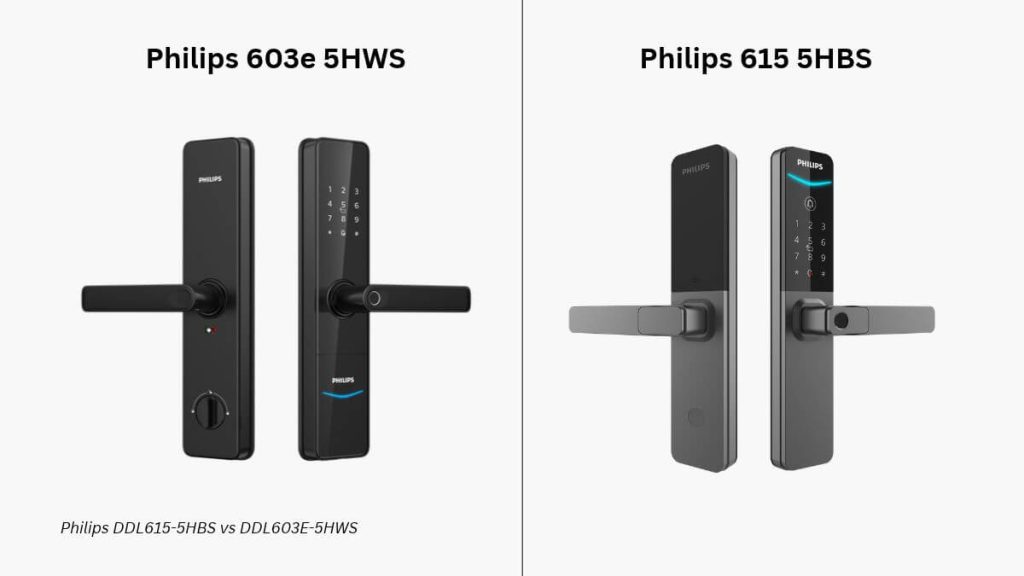
| Exterior Dimensions | Approx. 344.4 × 77.4 × 81.58 mm | Approx. 280 × 56 × 65 mm |
| Interior Dimensions | Approx. 344.4 × 77.4 × 81.65 mm | Approx. 280 × 56 × 61 mm |
| Door Thickness | 38–120 mm | 35–90 mm* |
| Mortise | 524 | 5050 / 3585 / 4585 |
| Battery | 8 × AA | 8 × AAA |
| Stated Battery Life | Approx. 10 months* | Approx. 5 months* |
| Operating Temperature | -20°C to +60°C | -20°C to +60°C |
| Operating Humidity | 15%–93% RH | 15%–93% RH |
| Reference Price | AED 1,742 | AED 750 |
*Actual installation range and battery life can vary. Door compatibility should be confirmed before purchase, and battery-life figures are based on manufacturer test conditions.
1. The Biggest Difference: Wi-Fi vs Bluetooth
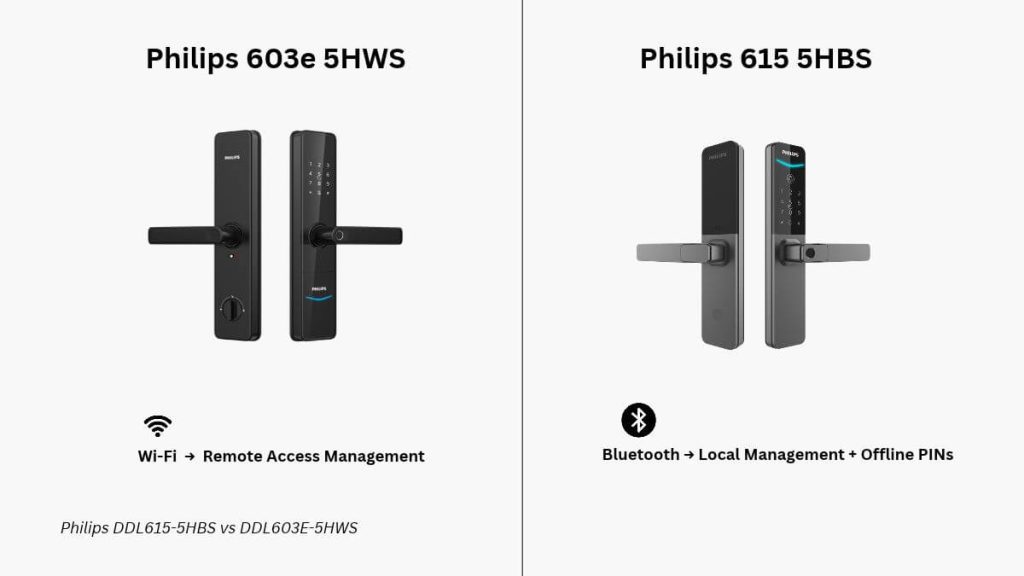
The Philips DDL603E is the stronger choice for connected remote access, while the Philips DDL615 focuses on Bluetooth-based local management and affordability.
Philips DDL603E-5HWS: Wi-Fi Connectivity
The Philips DDL603E-5HWS uses Wi-Fi connectivity and is designed for users who want greater flexibility when managing access away from the door.
Its connected features include functions such as:
- Temporary PIN distribution
- Access-record monitoring
- Remote access management
- Connected lock settings
This can be particularly useful for:
- Landlords
- Families with visitors
- Rental properties
- Property managers
- Homes with recurring service providers
If someone needs temporary access while you are away, remote PIN management can be much more practical than physically registering that person at the lock.
Philips DDL615-5HBS: Bluetooth Connectivity
The Philips DDL615-5HBS uses Bluetooth rather than built-in Wi-Fi.
Its app-connected functions focus on:
- Lock setup
- User management
- Access-log queries
- Offline access-control PIN management
One notable feature is support for up to 250 offline access-control PINs.
This gives the DDL615 useful access-management flexibility even though Wi-Fi is not its main connectivity method.
Bottom Line
DDL603E = stronger remote connectivity
DDL615 = simpler Bluetooth connectivity at a much lower price
2. Philips DDL615 vs DDL603E Dimensions
The Philips DDL615 is considerably smaller than the DDL603E, making it the better choice when compact dimensions and a slimmer appearance are important.
This is one of the clearest physical differences between the two models.
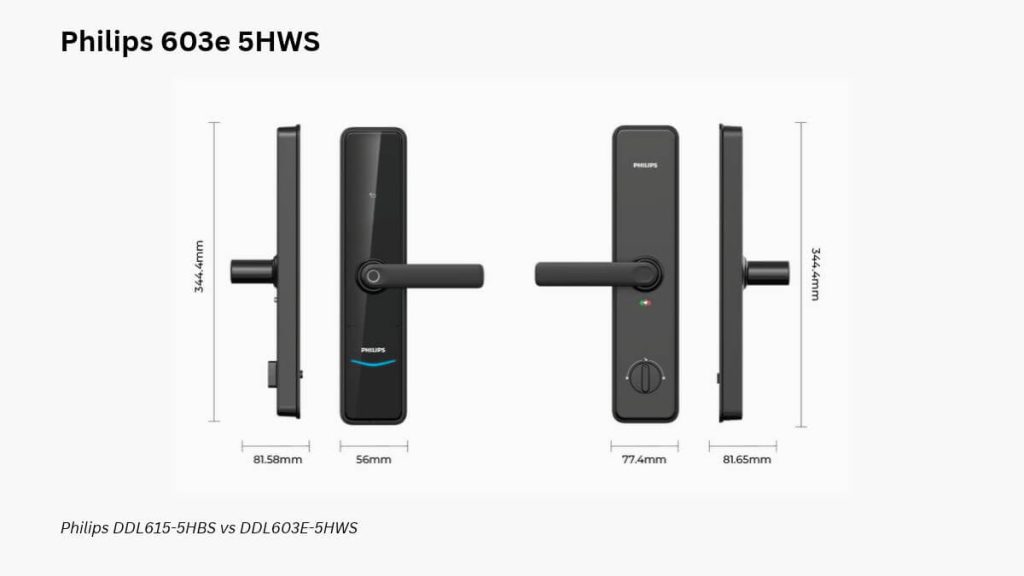
Philips DDL603E-5HWS Dimensions
The Philips DDL603E uses a taller traditional smart-lever design.
Approximate dimensions:
Exterior unit
- Height: 344.4 mm
- Width: 77.4 mm
- Depth: 81.58 mm
Interior unit
- Height: 344.4 mm
- Width: 77.4 mm
- Depth: 81.65 mm
The larger body gives the DDL603E a more substantial appearance on the door.
Philips DDL615-5HBS Dimensions
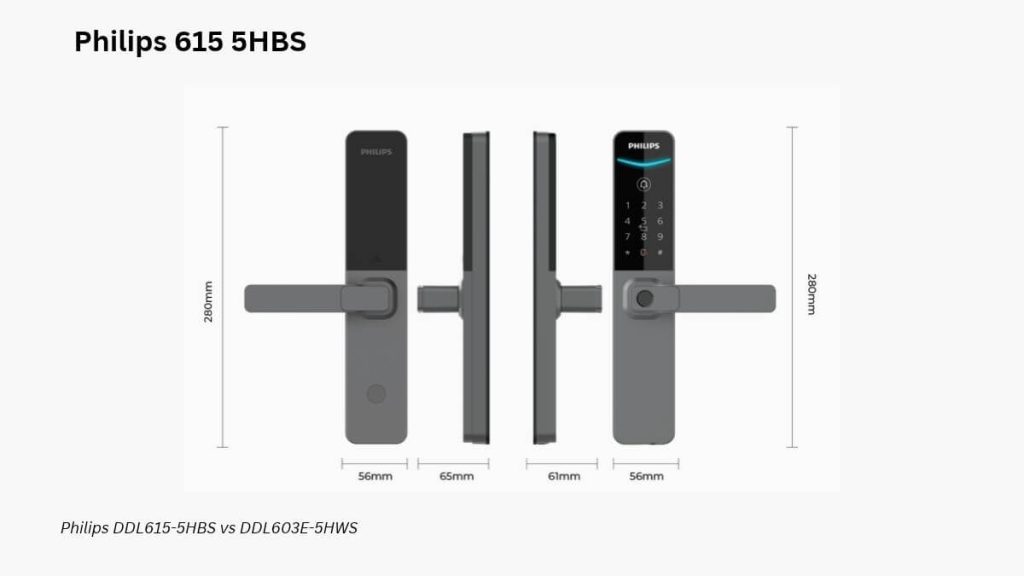
The DDL615 is noticeably more compact.
Approximate dimensions:
Exterior unit
- Height: 280 mm
- Width: 56 mm
- Depth: 65 mm
Interior unit
- Height: 280 mm
- Width: 56 mm
- Depth: 61 mm
At just 56 mm wide, the DDL615 has a much slimmer front profile than the DDL603E.
That can make it visually attractive on contemporary apartment doors, offices, and doors where a large smart-lock panel would feel excessive.
Which Is More Compact?
The Philips DDL615 wins clearly on size.
Its 280 mm height and 56 mm width make it substantially smaller than the 344.4 mm × 77.4 mm body of the Philips DDL603E.
However, dimensions alone do not determine whether either lock will fit your door.
Mortise dimensions, door thickness, backset, center distance, existing cut-outs, and opening direction must also be checked.
3. Price: The Philips DDL615 Is the More Affordable Option
The Philips DDL615 costs significantly less than the DDL603E based on OjiSmart’s supplied Philips price list.
Reference pricing:
Philips DDL603E-5HWS — AED 1,742
Philips DDL615-5HBS — AED 750
That is a difference of approximately AED 992.
This changes how the two locks should be compared.
The DDL603E should not really be viewed as the cheaper entry-level model. Instead, you are paying more primarily for its Wi-Fi connectivity and connected-access capabilities.
The DDL615 is the stronger value proposition when fingerprint, PIN, key-tag access, Bluetooth management, and a compact design already cover your needs.
Which Gives Better Value?
If you do not need built-in Wi-Fi, the DDL615 offers excellent value.
If managing access remotely is important to you, the additional cost of the DDL603E may be worthwhile.
Always check the current OjiSmart product page before purchasing, as prices and promotions may change.
4. Fingerprint, PIN and Keyless Access
Both models provide the core access methods most families expect from a modern Philips smart lock.
Philips DDL603E Access Methods
The DDL603E supports:
- Fingerprint
- PIN code
- Key tag
- Temporary PIN
- Mechanical key
Philips DDL615 Access Methods
The DDL615 supports:
- Fingerprint
- PIN code
- Key tag
- Mechanical key
- Offline access-control PIN management
Both models use a semiconductor fingerprint sensor.
Credential Capacity
Both models support approximately:
- 100 fingerprints
- 100 key tags
- 20 user PIN codes
The DDL615 additionally supports up to:
250 offline access-control PINs
For a normal apartment or family home, either lock offers considerably more user capacity than most households will ever require.
5. Security Features
The Philips DDL603E and DDL615 share several important access-security features despite their price difference.
Both models include:
- Hidden PIN
- Dual verification
- System locking
- Indoor deadlock
- Anti-dismantling or tamper protection
- Mechanical-key backup
What Is Dual Verification?
Dual verification allows the lock to require two authorized credentials instead of one before granting access.
This adds another layer of access control for users who want stronger verification.
For example, the lock may be configured to require two registered credentials rather than accepting a single fingerprint or PIN on its own.
What Is Hidden PIN?
Hidden PIN functionality allows additional digits to be entered around the correct PIN.
This can make it harder for someone nearby to identify your real password simply by watching the keypad.
6. Door Compatibility and Mortise Differences
This is where you should be careful: the DDL603E and DDL615 use different mortise configurations, so choosing the lock based only on features can lead to installation problems.
Philips DDL603E Door Requirements
The standard Philips specifications list door thicknesses of:
- 38–60 mm
- 60–90 mm
- 90–120 mm
The DDL603E is associated with the 524 mortise.
The Philips mortise documentation lists:
- Backset: 60 / 70 mm
- Center distance: 68 mm
Philips DDL615 Door Requirements
The standard listed ranges include:
- 35–60 mm
- 60–90 mm
- Other installation ranges may be possible depending on the door
The Philips DDL615 is associated with the 5050 mortise, with compatibility references also shown for 3585 and 4585 configurations.
The 5050 configuration uses:
- Backset: 50 mm
- Center distance: 50 mm
These measurements are very different from the DDL603E.
What Should Be Checked Before Installation?
Before buying either smart lock, check:
- Door thickness
- Existing mortise
- Existing lock cut-out
- Backset
- Center distance
- Door material
- Available panel width
- Handle clearance
- Door-opening direction
IMAGE 5 — INSERT MORTISE COMPARISON HERE
Show:
DDL603E → 524 Mortise
and
DDL615 → 5050 / 3585 / 4585
This is an excellent place to use your Philips technical mortise diagrams.
7. Battery Life and Emergency Power
Both smart locks are battery-powered, but they use different battery systems.
Philips DDL603E
Power:
8 × AA batteries
Manufacturer-stated battery life:
Approximately 10 months under laboratory test conditions
Philips DDL615
Power:
8 × AAA batteries
Manufacturer-stated battery life:
Approximately 5 months under laboratory test conditions
Actual battery life will depend on:
- Daily unlocking frequency
- Battery quality
- Connectivity usage
- Environmental conditions
- Lock configuration
Both locks also support 5V emergency power if the internal batteries become depleted.
This allows the lock to receive temporary external power so the user can regain access and replace the batteries.
8. Can the Philips DDL603E and DDL615 Handle UAE Humidity?
Both models are specified for operating humidity of 15%–93% RH, making humidity itself within the stated range acceptable under the manufacturer’s operating specifications.
Both models also list an operating temperature range of:
-20°C to +60°C
However, this should not automatically be interpreted as permission to install either model anywhere outdoors.
Environmental suitability depends on more than temperature and humidity.
Before installing a smart lock on an exposed villa entrance, gate, or outdoor-facing door in Dubai, factors such as direct sunlight, rain exposure, dust, door material, and installation position should also be considered.
For exposed installations, always confirm whether the exact smart-lock model has the appropriate environmental or IP protection for that location.
9. Which Is Better for Apartments?
For buyers who mainly want an affordable fingerprint smart lock, the DDL615 is the stronger value. For apartment owners who frequently manage access remotely, the DDL603E is more capable.
Choose the Philips DDL603E if:
- You want Wi-Fi connectivity
- You manage access while away
- Temporary PIN distribution is important
- You want connected access records
- Your door requires its wider standard thickness range
- Remote access management justifies the additional cost
Choose the Philips DDL615 if:
- You want a significantly lower purchase price
- Fingerprint, PIN, and key-tag access cover your needs
- You prefer a compact smart lock
- Bluetooth connectivity is enough
- You want flexible offline PIN management
- You don’t need built-in Wi-Fi
10. Which Is Better for Rental Properties?
The DDL603E is generally the stronger choice when remote management is the priority, while the DDL615 can work well when temporary code management is sufficient.
The DDL603E can be especially useful for:
- Landlords
- Managed apartments
- Long-term rentals
- Properties where family members or staff need temporary access
- Properties where the owner is frequently away
The DDL615 remains interesting because of its 250 offline access-control PIN capacity, particularly when users need flexible code-based access without relying on a Wi-Fi-first setup.
The right choice depends on whether you prioritize:
connected remote management
or
cost-effective local/code-based access management
11. Philips DDL615 vs DDL603E: Which Should You Buy?
For most price-conscious homeowners, the Philips DDL615-5HBS offers better value. For users who specifically need Wi-Fi connectivity and stronger remote access management, the Philips DDL603E-5HWS is the better choice.
Choose the Philips DDL603E when:
- Connectivity matters more than price
- Remote PIN management is important
- You want Wi-Fi access functions
- Your door matches the 524 mortise configuration
Choose the Philips DDL615 when:
- You want to spend less
- You prefer a compact 56 mm-wide lock
- Bluetooth connectivity is sufficient
- You want fingerprint, PIN, and key-tag access
- Offline PIN management is useful
- Your door suits the 5050 / compatible mortise configuration
Most importantly, check your door before choosing either lock.
The more expensive smart lock is not automatically the better smart lock.
The better model is the one that matches your door, your budget, your access requirements, and how you actually use the property.
You can also browse the complete range of Philips smart locks available from OjiSmart.
Frequently Asked Questions
What is the main difference between the Philips DDL615 and DDL603E?
The biggest difference is connectivity. The Philips DDL603E uses Wi-Fi, while the Philips DDL615 uses Bluetooth and focuses more heavily on compact design, affordability, and offline PIN management.
Which is cheaper: Philips DDL615 or DDL603E?
The Philips DDL615 is considerably cheaper based on OjiSmart’s supplied reference pricing.
DDL615: approximately AED 750
DDL603E: approximately AED 1,742
Prices may change, so check the current product listing before purchasing.
Which smart lock is smaller?
The Philips DDL615 is substantially more compact.
Its exterior unit measures approximately:
280 × 56 × 65 mm
compared with approximately:
344.4 × 77.4 × 81.58 mm
for the DDL603E.
Does the Philips DDL603E have Wi-Fi?
Yes. The Philips DDL603E-5HWS uses Wi-Fi connectivity for its supported connected-access functions.
Does the Philips DDL615 have Wi-Fi?
No. The Philips DDL615-5HBS uses Bluetooth connectivity.
Can both smart locks use fingerprints?
Yes. Both models use semiconductor fingerprint sensors and support up to approximately 100 fingerprints.
Do both models support PIN codes?
Yes. Both models support user PIN codes.
The DDL615 additionally supports up to 250 offline access-control PINs.
Can both models handle humidity?
Both models list an operating humidity range of 15%–93% RH and an operating temperature range of -20°C to +60°C.
The actual suitability of an outdoor installation still depends on exposure to rain, direct sunlight, dust, and the environmental protection of the specific model.
Which model supports thicker doors?
The standard DDL603E specification supports door thicknesses up to 120 mm.
The DDL615 standard ranges extend through 90 mm, with other installation ranges potentially available depending on the door.
Can I replace my existing lock with either model?
Not automatically.
The DDL603E and DDL615 use different mortise configurations. Your existing mortise, backset, center distance, door thickness, cut-outs, and opening direction should be checked before installation.