



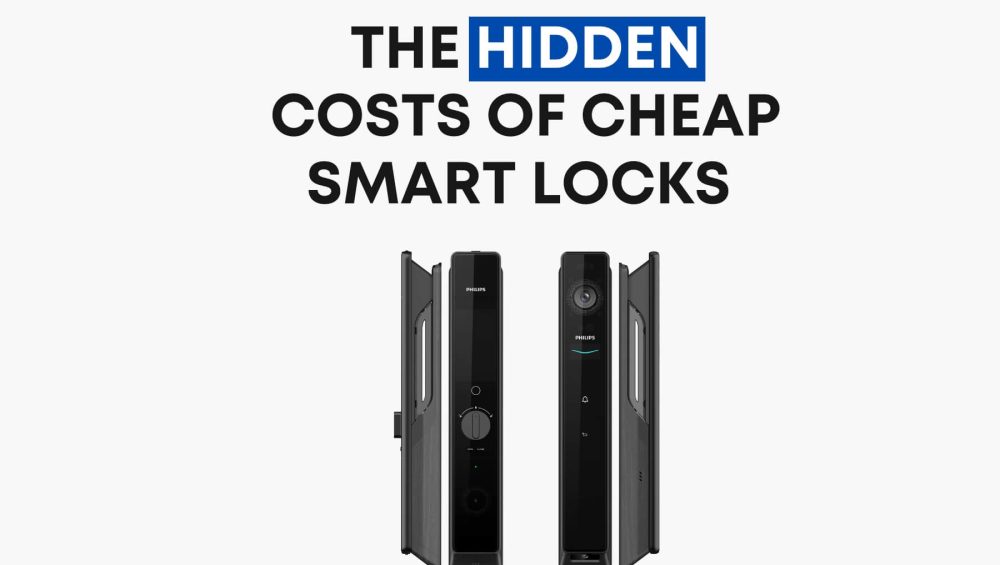
It’s tempting: buy a no-name smart lock online for half the price of Philips or Oji. After all, it unlocks with a fingerprint, right? But in practice, the UAE climate, daily usage, and lack of support quickly reveal hidden costs. From short battery life to failed sensors and even security risks, those initial savings disappear fast.
Investing in Philips or Oji means you pay once for proven durability, safety certifications, and real warranties—and avoid expensive headaches later.
1. Durability & Climate Resistance
Cheap imports:
- Often made with plastic casings or low-grade alloys.
- Sensors fail when exposed to 40 °C+ summers, humidity, or dust.
- Many aren’t tested for IP ratings (dust/water resistance).
Philips & Oji:
- Built with zinc alloy or aluminium alloy housings for strength.
- Tested in desert climates, with seals to resist dust and sand.
- Outdoor-ready models like Oji S617 or Philips DDL505 carry IP65 waterproof ratings.
Hidden cost of cheap locks: Replacements every 6–12 months due to weather damage.
2. Security & Compliance
Cheap imports:
- Rarely meet SIRA or CE certifications.
- Use basic encryption that can be hacked or bypassed.
- Limited to weak fingerprint sensors with high error rates.
Philips & Oji:
- Equipped with C-grade cylinders, multi-biometric security (palm, face, fingerprint).
- Compliance with SIRA, CE, and ISO standards ensures recognized security.
- Features like fake PIN, auto-locking, and tamper alarms make forced entry harder.
Hidden cost of cheap locks: A lock that looks secure but fails when it matters most.
3. Warranty & After-Sales Support
Cheap imports:
- Typically no UAE warranty—just a short seller guarantee.
- If the lock fails, you buy another one.
- No local technicians, no spare parts.
Philips & Oji:
- Covered by official warranties (1–3 years).
- UAE-based service teams provide repairs, replacements, and installation help.
- Long-term parts support—no need to throw the lock away.
Hidden cost of cheap locks: Buying two or three replacements instead of one reliable lock.
4. Battery & Power Management
Cheap imports:
- Inconsistent power efficiency—Wi-Fi drains batteries in weeks.
- Limited backup options; many don’t support Type-C emergency power.
- Frequent failures due to overheating batteries in UAE summers.
Philips & Oji:
- Optimized low-power BLE and gateway design.
- Type-C emergency charging ensures access even if batteries die.
- Up to 6–12 months battery life under normal use.
Hidden cost of cheap locks: Constantly buying batteries—or worse, being locked out when they fail.
5. Safety Features You Actually Need
Cheap imports:
- Often lack fire-safety certifications.
- No auto-unlock function during emergencies.
- Touchscreens degrade quickly, leading to malfunctions.
Philips & Oji:
- Built-in auto-unlock safety knobs.
- Fire-tested materials to handle heat stress.
- Smart alerts, visitor logs, and photo capture for real monitoring.
Hidden cost of cheap locks: Safety risks for your family and property.
6. Total Cost of Ownership
Let’s break it down over 3 years:
- Cheap import (≈ 400 AED upfront): Replace twice, buy extra batteries, no warranty, possible door repair after failure → ≈ 1,500 AED.
- Philips/Oji (≈ 1,200–1,800 AED upfront): One purchase, warranty coverage, longer battery life → ≈ 1,200–1,800 AED total.
Cheap looks cheaper—but costs more long-term.
Conclusion: Invest Once, Protect for Years
Cheap smart locks may work for a few weeks, but they don’t last in the UAE’s climate, nor do they offer trusted safety. With Philips and Oji, you invest in certified security, durable design, and real support—saving you money, time, and stress long-term. When security is at stake, the lowest price is rarely the best deal.